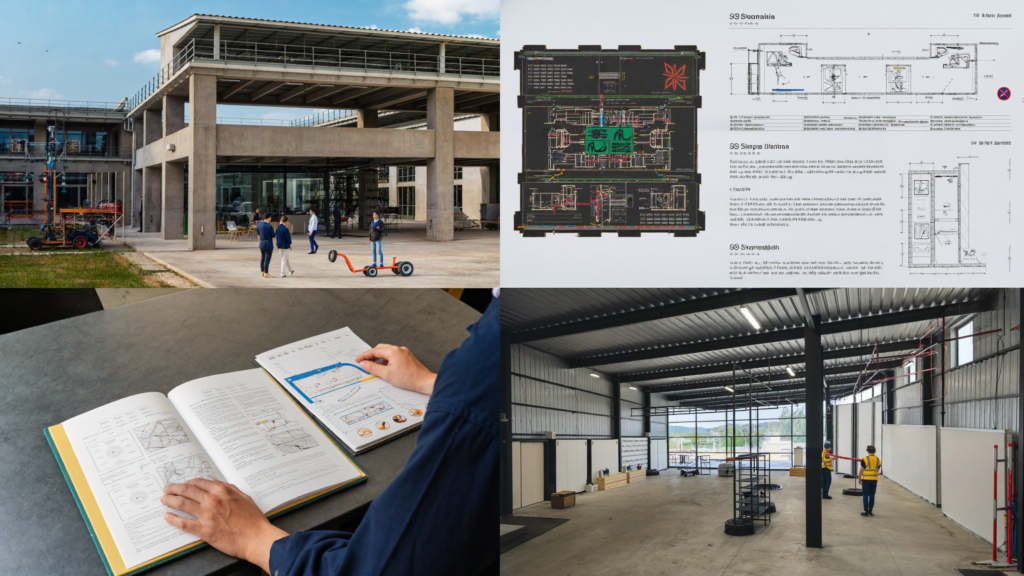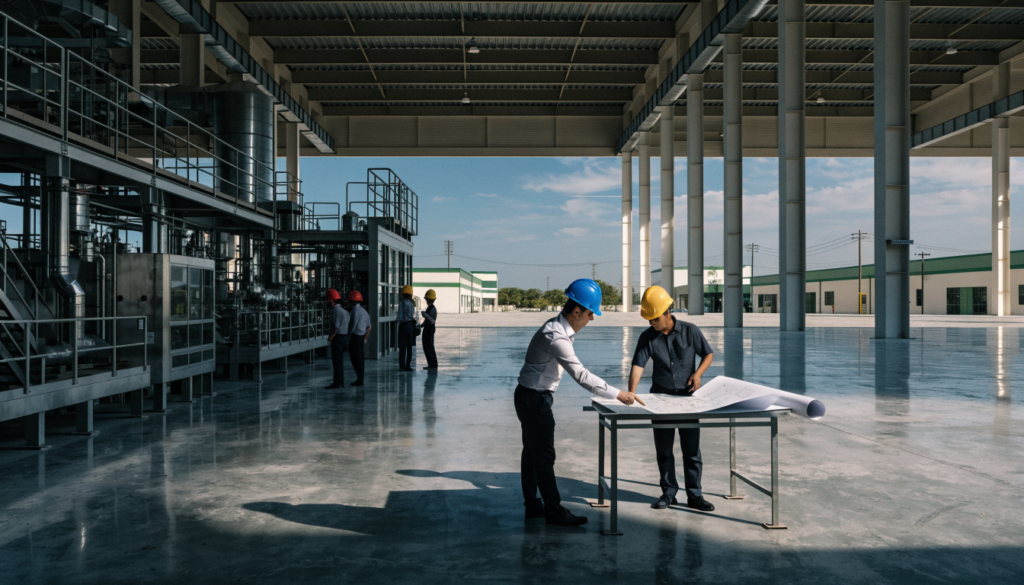
Factory setup in Indonesia is a coordinated investment project, not a sequence of company registration followed by construction. The business activity and ownership structure, industrial location, land rights, spatial conformity, environmental approval, factory design, building approval, utilities, machinery, workforce, product standards, and operating licence all depend on one another. A decision made too early in one workstream can constrain the entire plant.
This guide follows the practical project sequence for a foreign manufacturer, from defining the production model and selecting a site through construction, commissioning, and ongoing compliance. It highlights the decisions that should be locked before capital is committed and the approvals that require project-specific verification.
Key Takeaways
- Confirm the manufacturing activity, products, process, scale, inputs, emissions, utilities, and sales model before selecting KBLI codes or land.
- Foreign ownership eligibility and the appropriate Indonesian entity structure depend on the actual business activities and current investment rules.
- A low-priced site can be expensive if zoning, industrial-location policy, access, utilities, geotechnical conditions, flooding, or environmental capacity do not support the plant.
- Risk-based licensing through OSS, spatial conformity, environmental approval, PBG, SLF, industrial obligations, and sector approvals should be managed as connected workstreams.
- Equipment layout and production-process data are needed early because they affect buildings, utilities, environmental studies, fire and safety systems, and product approvals.
- Commissioning should proceed through formal readiness gates covering licences, building use, machinery, workforce, quality, waste, emergency, and reporting controls.
Start With the Operating Model
A factory plan should answer what will be made, from which inputs, through which process, at what capacity, on which equipment, for which customers, and under which product standards. Record whether goods will be sold domestically, exported, imported as components, processed under contract, stored for third parties, or serviced after sale. These facts shape the legal entity, KBLI selection, importer profile, licences, location, facility design, and tax model.
Indonesia’s current risk-based licensing framework is set by Government Regulation No. 28 of 2025, which replaced the 2021 framework. The official OSS portal explains that businesses are grouped by risk level and that the risk level determines the licensing obligations. The result must be checked against the exact KBLI activity and project data.
A plant can involve several activities beyond core production: warehousing, wholesale trading, importing, waste treatment, power generation, laboratories, maintenance, or logistics. Add only activities that the company will genuinely perform and verify whether they create separate approvals or foreign-ownership considerations.
Choose and Establish the Right Indonesian Entity
A foreign manufacturer commonly evaluates an Indonesian foreign-investment company for an owned operating plant, but the appropriate structure depends on ownership eligibility, joint-venture strategy, land and asset arrangements, customers, incentives, financing, and risk allocation. Incorporation alone does not authorise construction or production.
The entity file should be consistent across the deed and corporate approvals, tax registration, OSS account, NIB, KBLI activities, shareholder and management data, project location, investment plan, and intended licences. Where land or construction commitments precede full operating readiness, use conditions precedent and clear allocation of permitting risk.
Separate the roles of landowner, developer, building owner, tenant, factory operator, importer, manufacturer, product-registration holder, employer, and utility customer. One company may perform several roles, but contracts and official records should reflect the real arrangement. IndoGateway’s factory setup support in Indonesia coordinates these dependencies.
Factory Site Selection and Due Diligence
Indonesia’s industrial-location framework is governed in part by Government Regulation No. 20 of 2024 on industrial zoning. Location analysis should consider the spatial plan, industrial-designated area, industrial-estate requirements and exceptions, environmental carrying capacity, transport links, labour, utilities, and supply chain.
Run legal, technical, environmental, and commercial due diligence before signing an unconditional lease or land acquisition. Verify the land title or lawful control, registered owner, boundaries, encumbrances, disputes, access, permitted use, developer authority, estate rules, and utility commitments. A marketing plan or broker statement does not prove that the intended process is allowed.
Technical site checks
- topography, soil and geotechnical conditions, seismic design basis, and earthworks;
- flood, drainage, stormwater, coastal, subsidence, and neighbouring-use risks;
- road geometry, bridge limits, port or rail access, and abnormal-load routes;
- electricity capacity and reliability, fuel, water source, wastewater capacity, telecommunications, and redundancy;
- setbacks, height, coverage, fire access, parking, expansion space, and employee transport;
- estate service charges, utility tariffs, construction controls, and handover conditions.
Ask for evidence and test critical representations with the relevant estate operator, utility, technical consultant, and authority. IndoGateway’s factory site-selection service can support a multi-criteria comparison.
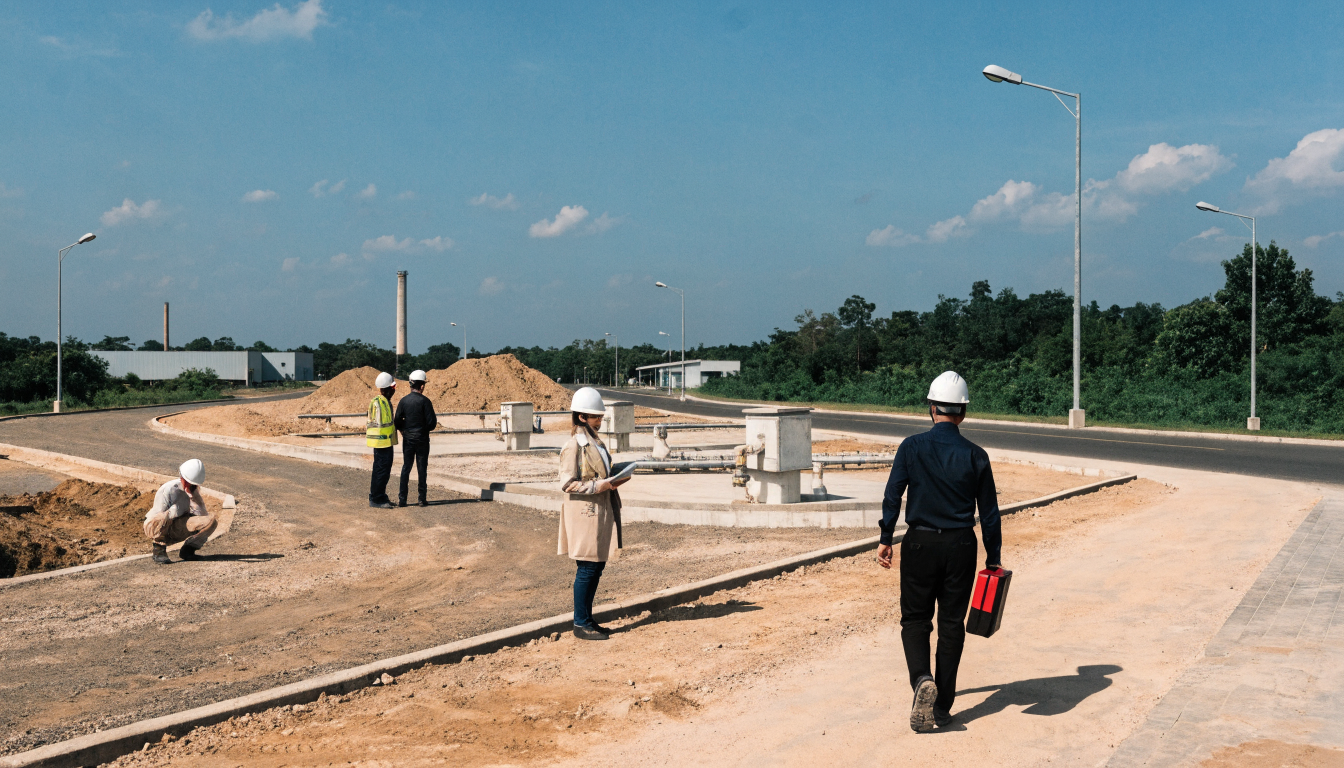
Map the Approval Workstreams Before Design Freeze
| Workstream | Why it affects design | Project dependency |
|---|---|---|
| OSS and industrial licensing | Defines licensed activity, risk level, standards, and operating evidence | KBLI, scale, products, process, location, and entity |
| Spatial conformity and land | Determines whether the activity and building can use the site | Coordinates, land status, spatial plan, estate, and layout |
| Environmental approval | Can shape capacity, emissions, wastewater, waste, traffic, and monitoring | Process, inputs, output, location, thresholds, and impacts |
| PBG and technical building compliance | Controls approved building design and construction standards | Function, occupancy, structure, fire systems, architecture, and site plan |
| SLF and commissioning | Confirms building fitness before use under the applicable process | As-built work, inspections, systems, documents, and PBG conformity |
| Product and sector approvals | Can impose facility, line, laboratory, quality, storage, or personnel requirements | Product category, market, claims, standards, and regulator |
Government Regulation No. 28 of 2025 integrates basic requirements, business licensing, supporting licences, supervision, and OSS administration. The detailed licence outcome must be generated and verified for the project rather than inferred from another factory’s file.

Environmental Approval Is a Design Input
Government Regulation No. 22 of 2021 governs environmental protection and management, including environmental approvals and controls for water, air, hazardous and non-hazardous waste, and enforcement. The applicable environmental document may be AMDAL, UKL-UPL, or SPPL depending on the activity, scale, location, and impact criteria. It should never be selected from company size alone.
Start the environmental basis with accurate mass and energy balances: raw materials, chemicals, water, fuel, energy, products, by-products, wastewater, air emissions, noise, odour, traffic, hazardous materials, and waste. Define normal, peak, startup, shutdown, maintenance, and emergency conditions. If this information changes after approval, the project may need a formal reassessment.
Environmental design should connect process equipment with wastewater treatment, air-pollution controls, hazardous-material storage, waste areas, drainage, spill containment, monitoring points, and emergency response. Current issuance and review processes should also be checked against Ministry of Environment/BPLH Regulation No. 22 of 2025 and applicable local or sector rules.
For planning support, compare AMDAL environmental approval with UKL-UPL and SPPL requirements.
Design, PBG and Construction Control
A factory design should integrate production flow, material segregation, personnel movement, hygiene or clean areas, maintenance access, fire and life safety, structural loads, machinery foundations, utilities, wastewater, waste, loading, security, and expansion. Product regimes such as food, cosmetics, pharmaceuticals, medical devices, chemicals, or mandatory SNI can add facility and quality-system requirements.
Indonesia uses Persetujuan Bangunan Gedung, or PBG, for building approval and Sertifikat Laik Fungsi, or SLF, for building fitness before use under the applicable framework. The official SIMBG platform states that PBG supports entry into construction after technical standards are met and that SLF confirms a building is fit for use after construction.
Design control is essential. Establish a signed basis of design, drawing register, approval matrix, change procedure, and responsibility split between owner, estate, designer, contractor, equipment vendors, and inspectors. A change that appears minor to procurement can affect PBG, environmental approval, fire systems, product certification, or commissioning.
See IndoGateway’s PBG building approval, SLF certification, and factory construction and environmental coordination.
Machinery, Imports and Utilities
Prepare an equipment register with technical specifications, HS codes, condition, origin, manufacturer, power and utility demand, hazardous characteristics, pressure or lifting functions, foundation loads, and regulatory certificates. Confirm whether import restrictions, used-machinery permissions, SNI, inspection, registration, or technical approvals apply before placing orders or shipping.
The importer model must match the transaction. If the operating company imports machinery or raw materials, its business licensing, NIB importer function, customs access, and product permissions should be ready. Temporary import, bonded facilities, incentives, or special zones may change the analysis, but eligibility and economics require transaction-specific customs and tax advice.
Utility commitments should specify capacity, voltage or pressure, quality, connection point, redundancy, construction scope, deposits, metering, and energisation conditions. Test whether promised utility capacity is currently available or only planned. The commissioning sequence must allow time for permanent power, water, wastewater acceptance, fuel, data, and emergency systems.
Workforce, Safety and Operating Systems
Build an organisation plan covering directors, plant leadership, engineering, production, maintenance, quality, EHS, warehouse, procurement, finance, IT, security, and required technical personnel. Determine which roles can be filled locally, which require training, and whether any foreign personnel need immigration and work authorisation. Role titles and qualifications should be checked against current sector and manpower rules.
Before startup, establish employment documentation, payroll and social-security administration, working-time arrangements, contractor management, safety procedures, emergency teams, competence matrices, permits to work, incident reporting, and medical or hygiene programmes appropriate to the process. Equipment training should be scheduled before vendor specialists leave the site.
Quality, halal, food safety, GMP, traceability, laboratory, calibration, product release, warranty, recall, and customer-audit systems may be needed depending on the product. These are not paperwork added after production; they affect room design, material flow, equipment qualification, data systems, and staffing.
Commissioning and Operational Readiness
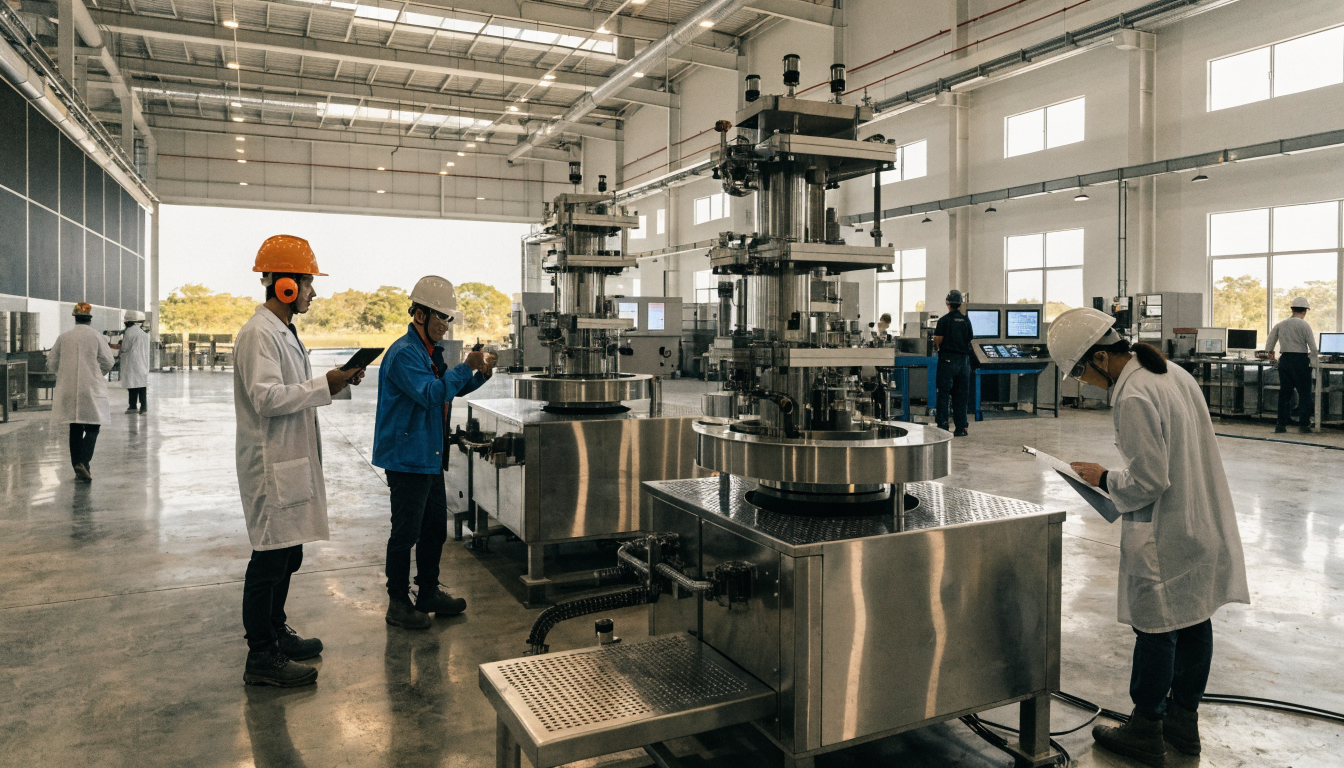
Commissioning proves that installed systems perform as designed and that the organisation can operate them safely and compliantly. Use system boundaries and acceptance criteria for electrical distribution, utilities, fire protection, ventilation, process equipment, control systems, wastewater treatment, laboratories, warehousing, and emergency systems.
An operational-readiness gate should confirm that licences and environmental commitments match the final facility; PBG and SLF stages are complete as applicable; utilities are permanent; machinery is accepted; inspections are closed; standard operating procedures are issued; operators are competent; materials are approved; waste contractors are ready; emergency drills are complete; and product release authority is established.
Do not confuse mechanical completion, first power, trial production, and commercial operation. Each stage has different safety, regulatory, quality, tax, customer, and insurance implications. Record who authorises each transition and what evidence is required.
Ongoing Industrial Compliance
After startup, the factory must maintain its licensing and reporting position as operations change. Indonesia’s Ministry of Industry uses SIINas for industrial data and services, and official information on industrial data reporting under Ministry of Industry Regulation No. 13 of 2025 confirms periodic reporting obligations through the system.
Maintain a compliance calendar for OSS and sector licences, investment reporting, environmental monitoring, waste manifests, building and equipment inspections, workforce and immigration, product approvals, tax and customs, SIINas, standards, and certifications. The exact calendar depends on the project.
Use management of change for new products, higher capacity, alternative fuels, new chemicals, line relocation, warehouse expansion, different waste treatment, ownership changes, or added business activities. Assess regulatory and design impacts before procurement or implementation.
Common Factory Setup Mistakes
- Choosing a site before confirming the production process, KBLI, spatial fit, environmental pathway, and utility demand.
- Treating a developer’s permit or estate approval as the factory operator’s complete licence.
- Freezing architecture before equipment, material flow, fire, quality, and environmental requirements are known.
- Ordering machinery before import eligibility, HS classification, foundation, utilities, inspection, and certification are checked.
- Using generic environmental data that does not match actual capacity, chemicals, emissions, wastewater, or waste.
- Starting occupancy or commercial use before the applicable building and operating readiness stages are complete.
- Leaving product certification, BPOM, halal, SNI, or customer qualification until after construction.
- Planning to compliance deadlines without schedule contingency for design changes, agency review, inspections, and corrective work.
Frequently Asked Questions
1. Can a foreign company own and operate a factory in Indonesia?
A foreign investor can often participate through an Indonesian foreign-investment company, but eligibility and permitted ownership depend on the selected business activities and current investment rules. The entity must then obtain the licences and approvals relevant to its KBLI, risk level, site, process, products, and operations. Incorporation does not by itself authorise land use, construction, production, import, or product sale. Before committing capital, verify ownership, shareholders, land structure, industrial location, OSS outcome, environmental pathway, building approvals, product requirements, and any sector-specific conditions as one project.
2. Must a factory be located in an industrial estate?
Indonesia regulates industrial zoning and industrial estates, but the applicable location requirement and any exception must be assessed under Government Regulation No. 20 of 2024 and current implementing rules. Do not assume that any commercially zoned or warehouse site can host manufacturing. Check the spatial plan, industrial designation, estate status, process impacts, utilities, access, and local conditions for the exact coordinates. Even inside an industrial estate, the operator still needs its own entity, business licensing, environmental, building, sector, and operational compliance. Obtain written evidence before signing an unconditional land commitment.
3. What licences are needed to set up a factory in Indonesia?
There is no universal factory-licence checklist. A project may involve an NIB and risk-based business licence through OSS, spatial conformity, environmental approval, industrial and supporting licences, PBG, SLF, machinery or equipment approvals, import permissions, workforce authorisations, and product-specific registrations or standards. The actual set depends on KBLI, risk level, ownership, location, land, building, process, capacity, materials, emissions, utilities, products, and sales model. Generate a project-specific obligations register and identify the prerequisite, responsible authority, evidence, and required project stage for each item.
4. Does a factory need AMDAL, UKL-UPL, or SPPL?
The applicable environmental document depends on the activity, scale, location, impact criteria, and current environmental rules; it should not be selected solely from company size or a neighbouring factory’s experience. Prepare accurate process, capacity, input, energy, water, emission, wastewater, waste, traffic, and hazardous-material data, then assess the project under Government Regulation No. 22 of 2021 and current implementing provisions. Environmental approval should be completed at the correct project stage and reflected in design. Material changes can require reassessment before they are built or operated.
5. What is the difference between PBG and SLF for a factory?
PBG is the building approval associated with compliance of the proposed building with applicable technical standards and supports the construction stage. SLF is the certificate confirming the building is fit for use after completion under the relevant process. The official SIMBG platform administers these building procedures. A factory should align function, site plan, structure, fire and life safety, architecture, utilities, process loads, and as-built records throughout design and construction. Project-specific requirements, inspections, local responsibilities, and sequencing should be confirmed before construction and again before occupancy.
6. How long does factory setup in Indonesia take?
No reliable universal timeline exists. The schedule depends on site readiness, land and spatial checks, entity and investment structure, environmental pathway, design maturity, PBG review, estate approvals, utility connections, procurement lead times, machinery import, construction, inspections, SLF, workforce recruitment, product approvals, and commissioning findings. Develop a logic-linked schedule with decision gates and contingency rather than adding generic durations. Begin long-lead regulatory, utility, product, and equipment workstreams early, but do not start irreversible construction or shipment until the required prerequisites have been verified for the project.
7. Can machinery be imported before the factory is fully licensed?
Do not assume that early machinery import is permitted or commercially sensible. The importing party needs the appropriate importer and customs position, while the equipment must be correctly classified and checked for restrictions, condition rules, technical standards, inspections, and supporting approvals. The site also needs secure storage, access, foundations, utilities, insurance, and an installation plan. Incentive, bonded, temporary-import, or project arrangements can alter the analysis. Obtain customs, tax, licensing, and technical advice for the exact equipment and transaction before ordering or dispatching machinery.
8. When is a factory ready to begin commercial production?
A factory is ready only when the applicable legal, building, environmental, technical, safety, quality, workforce, and product conditions for commercial operation are satisfied and the owner’s acceptance criteria are met. Mechanical completion or a successful equipment test is not enough. Confirm licences, environmental commitments, building-use status, permanent utilities, machinery acceptance, inspection closure, trained operators, approved materials, waste arrangements, emergency readiness, traceability, laboratory and release systems, product approvals, insurance, and reporting. Use a signed operational-readiness gate that distinguishes commissioning, trial production, validation, customer qualification, and commercial release.
Conclusion
A successful factory setup in Indonesia begins with an accurate operating model and a verified site, then moves through coordinated entity, OSS, industrial, environmental, building, utility, machinery, workforce, product, and commissioning workstreams. The project should make approvals and evidence visible in the master schedule before capital commitments become difficult to reverse.
Regulatory note: Indonesian investment, licensing, tax, immigration, product, environmental and operating requirements may change and may depend on the business activity, ownership structure, location, products and project circumstances. This article provides general information and is not project-specific legal, tax or regulatory advice. Applicable requirements should be verified before implementation.
Build an Integrated Indonesia Factory Plan
IndoGateway helps foreign manufacturers connect entity and licensing strategy with site selection, environmental approval, factory design, construction, PBG, SLF, machinery, and operational readiness. To turn a production concept into a project-specific workstream map, contact IndoGateway.