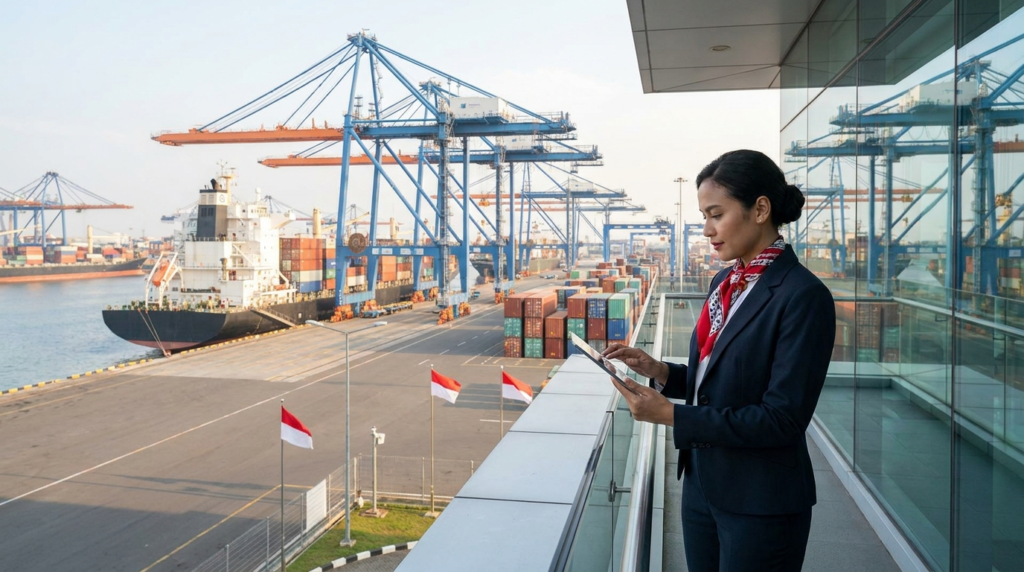
A foreign company can manufacture an excellent product and still choose the wrong route into Indonesia. The importer named in the transaction sits at the centre of customs declarations, import permissions, duties and taxes, product documentation, and regulatory accountability. That role also affects who controls inventory, market authorisations, data, and the ability to change partners later.
This guide explains what businesses usually mean by an importer of record in Indonesia, how the role relates to Indonesian licensing, and the three operating models most foreign companies consider. It also provides a due-diligence and contracting framework for selecting an importer without treating compliance as a simple logistics purchase.
Key Takeaways
- “Importer of record” is a practical international trade term; Indonesian eligibility comes from the actual importer’s business licensing, NIB importer function, customs access, and product permissions.
- A freight forwarder or customs broker is not automatically the importer, even when it manages transport or declarations.
- Foreign companies generally compare an own Indonesian entity, a distributor that imports, and a specialist third-party importer.
- The right model depends on the product, HS code, sales structure, market duration, risk allocation, and desired control over registrations and customer data.
- The importer’s licence scope must be checked for the exact goods and transaction; a generic promise of “IOR coverage” is not enough.
- Contracts should address customs data, duties and taxes, product registrations, recalls, rejected goods, audits, stock, and an executable exit plan.
What Does Importer of Record Mean in Indonesia?
In commercial usage, the importer of record is the party identified as the importer for the shipment and responsible for satisfying the obligations attached to importation. Indonesia’s official systems focus on the licensed Indonesian importer, its business identity, customs access, declarations, and the approvals applicable to the goods. The phrase “importer of record licence” should therefore not be understood as the name of one universal permit.
Indonesia Customs states that users carrying out customs obligations must complete customs registration and explains how a valid NIB can function as company registration, importer identification and customs access. See the official customs registration guidance. The importer must also work within the current risk-based licensing framework under Government Regulation No. 28 of 2025 and applicable trade and sector rules.
The importer may engage a customs broker to submit a declaration and a freight forwarder to coordinate transport. Those appointments do not make the underlying importer eligibility disappear. A sound structure identifies the licensed importer, the declarant or broker, the owner and buyer of the goods, the distributor, and the product-registration holder separately, even if one Indonesian company performs several roles.

Why the Choice Matters Beyond Customs Clearance
The importer model shapes the entire market-entry chain. It can determine who appears on labels and registrations, who pays import duties and taxes, who records landed inventory, who responds to an inspection, and who retains shipment records. It can also influence transfer pricing, revenue flows, distributor margins, warranty obligations, returns, and product-recall execution.
A model that works for a one-off installation may be unsuitable for repeated retail sales. Likewise, a distributor capable of importing ordinary equipment may not be eligible to import a regulated food, cosmetic, medical device, telecoms product, or controlled industrial input. The assessment must begin with the exact products and intended use, then connect regulatory requirements to the commercial chain.
This is why an importer and distributor comparison is valuable. Importation and distribution are related, but they are not identical functions and do not have to be assigned to the same counterparty in every model.
Three Importer of Record Options for Foreign Companies
| Model | Best suited to | Main control point | Main dependency |
|---|---|---|---|
| Own eligible Indonesian entity | Long-term or strategic market presence, repeated imports, inventory ownership, direct local operations | Greater control over licences, data, stock and counterparties | Entity, investment, tax, staffing, OSS, customs and ongoing compliance |
| Licensed distributor as importer | Products sold through a committed local channel partner | Integrated import and sales execution | Distributor performance and control of registrations, stock and market data |
| Specialist third-party importer | Defined projects, early market entry, or a structure separating import from distribution | Potential flexibility in downstream channels | Provider eligibility for the exact goods and clarity of transaction, tax and liability model |
Option 1: Use your own Indonesian entity
A foreign-owned group may establish or use an eligible Indonesian company and build the required importer, customs, product, tax, warehouse, and distribution capabilities. This model can support direct control over suppliers, inventory, declarations, product registrations, sales channels, and compliance records. It is most compelling when Indonesia is a durable market rather than an isolated shipment destination.
The company’s foreign ownership eligibility, KBLI activities, risk-based licences, NIB importer profile, customs access, and facilities must support what it actually does. An entity established for consulting, for example, should not be assumed to support a separate trading or regulated-product model. Review IndoGateway’s NIB and OSS licensing support when evaluating this foundation.
Option 2: Appoint a distributor that also imports
A local distributor can combine importation, inventory, sales, logistics, and customer support. This may simplify the chain and align the importer’s incentive with sell-through. For regulated products, the distributor may also serve as applicant or holder of a market authorisation where the relevant rules permit or require that structure.
The efficiency comes with concentration risk. If the distributor controls product registrations, customs records, customer relationships, and stock, replacing it may be difficult. The foreign principal should negotiate reporting, audit access, minimum compliance standards, recall cooperation, change-of-control protection, use of trademarks, and the treatment of registrations and remaining inventory at termination.
Option 3: Use a specialist third-party importer
A specialist importer can separate import execution from downstream distribution. This can be useful for a defined project, equipment deployment, testing phase, or multi-channel strategy. It may also give the foreign company time to validate demand before investing in a fully operational local entity.
The label “IOR provider” does not establish legal capacity. The provider’s KBLI scope, importer profile, customs access, product permissions, facilities, and transaction model must cover the actual shipment. The parties also need a lawful and coherent structure for purchase and resale, title, valuation, taxes, payment flows, and delivery to the Indonesian customer. A provider should be willing to show evidence and explain exactly how its name and licences will be used.

Product Classification Comes Before Provider Selection
Before requesting an importer quotation, prepare a product master with the technical name, composition or materials, function, specifications, model, brand, country of origin, manufacturer, intended use, and Indonesian customer. Use these facts to establish an HS classification and check the current restrictions in the Indonesia National Trade Repository.
Indonesia’s general import policy is set out in Ministry of Trade Regulation No. 16 of 2025, as amended by Regulation No. 37 of 2025. Additional commodity rules can impose an import approval, surveyor report, technical recommendation, registration, standard, quarantine measure, or other condition.
An importer that can handle one HS code may not be eligible for another. Product registration may also be tied to a particular Indonesian applicant. IndoGateway’s import and product compliance review is designed to connect these product-level questions to the proposed importer structure.
Importer Due Diligence Checklist
Ask the proposed importer to substantiate its role before discussing shipment dates. A proportionate review should cover:
- legal name, registered address, tax identity, ownership, authorised representatives, and current good standing;
- NIB, relevant KBLI activities, risk-based business licences, importer profile, and customs access;
- experience and current eligibility for the exact HS codes and product categories;
- product registrations, import approvals, technical recommendations, certificates, or facility requirements;
- customs broker appointment, document controls, classification and valuation process, and record retention;
- warehouse arrangements, traceability, rejected-goods procedures, recall capability, and insurance;
- sanctions, disputes, material compliance incidents, licence suspensions, or unresolved audits, where lawfully discoverable;
- tax invoicing, payment flow, duty and tax evidence, and reconciliation of landed cost;
- data security, confidentiality, subcontractors, and access to shipment records.
Evidence should be reviewed for current validity and consistency. A screenshot or marketing deck is not a substitute for official records and a transaction-specific explanation.

Contract Terms That Protect Market Continuity
The agreement should describe the importer’s services without obscuring the underlying sale and import transaction. Address who buys from the foreign seller, when title and risk pass, how the customs value is supported, who funds duties and taxes, and how the goods are sold or delivered in Indonesia. Align the contract with invoices, payment flows, Incoterms, declarations, and local tax records.
Regulatory control
Specify who applies for and owns product registrations, who maintains dossiers, who responds to authorities, and who bears the cost of variations or renewals. Where a registration cannot simply be transferred, the agreement should state the cooperation required to transition, replace, or close it lawfully. Include access to declarations, permits, test results, inspection correspondence, and distribution records.
Operational failures
Allocate responsibility for incorrect data, denied permits, customs queries, examinations, storage, demurrage, destruction, return, recall, and re-export. Insurance and liability provisions should reflect the product and the value at risk. Avoid clauses that promise regulatory approval or a guaranteed clearance time.
Exit and transition
Plan for termination before the first shipment. Cover remaining inventory, open orders, registration files, customer warranties, spare parts, returns, confidential data, and assistance to a replacement importer. Market continuity is materially stronger when the foreign brand can retrieve a complete compliance record instead of rebuilding it after a dispute.
A Pre-Shipment Gate for IOR Transactions
- Confirm the final product classification and current import requirements.
- Verify the importer’s licences, customs access, and product permissions for the exact goods.
- Confirm that required product registration or import approval is issued and matches the product, applicant, manufacturer, and variant.
- Reconcile the purchase order, commercial invoice, packing list, transport document, origin evidence, and permit data.
- Approve the valuation method, Incoterms, duty and tax funding, and documentary payment flow.
- Confirm the local consignee, warehouse, final customer, delivery record, and post-entry document owner.
- Obtain written shipment release from the importer and its authorised customs representative.
Indonesia Customs identifies the import declaration and supporting documents, including invoice, packing list, transport document, product-identification materials, and evidence of import requirements, in its official overview of imports for use. The gate should be adapted to the actual commodity and port process.
Common Red Flags
- The provider will not disclose which legal entity will be named as importer.
- The quotation says “all products covered” before reviewing specifications or HS codes.
- The proposed classification is selected only to lower duty or avoid a restriction.
- The provider asks the supplier to ship before product approvals are issued.
- The invoice, title flow, payment flow, and customs value do not describe the same transaction.
- The provider cannot explain who owns registrations or how the brand can transition to a replacement partner.
- Customs entries, duty evidence, permits, or inspection records will not be shared with the foreign principal.
- A broker or forwarder is described as absorbing every regulatory liability without identifying the licensed importer.
Frequently Asked Questions
1. Is importer of record a specific licence in Indonesia?
No. “Importer of record” is commonly used to describe the party identified as importer and responsible for import compliance, but Indonesian eligibility is established through the actual company’s registrations and permissions. These can include an NIB that reflects the importer function and customs access, suitable KBLI activities and risk-based licences, plus product or commodity approvals. The precise requirements depend on the goods, HS classification, use, origin, and transaction. A provider’s statement that it offers IOR services should therefore be verified against official company and product records.
2. Can an overseas company be the importer of record in Indonesia?
For an ordinary commercial import model, foreign suppliers should plan on an eligible Indonesian party being identified as importer and fulfilling the local licensing and customs requirements. The foreign company may use its own properly established Indonesian subsidiary or appoint a qualified local importer. Special procedures may exist for particular temporary, personal, diplomatic, project, or sector situations, but they should not be extrapolated to routine sales. The appropriate structure must be confirmed against the exact product, transaction, intended use, and current official rules before cargo is dispatched.
3. Is the customs broker the importer of record?
Not automatically. A customs broker may prepare and submit import declarations on behalf of an authorised party, while the importer is the entity whose importer identity, permissions, and transaction underpin the entry. A freight forwarder may separately arrange carriage and delivery. One company can offer multiple services, but the contract and customs file should state each role clearly. Ask whose NIB, importer profile, and product licences are being used; who appears on the declaration; who pays duties and taxes; and who must answer a post-clearance customs or product-compliance inquiry.
4. Can one Indonesian importer handle every type of product?
No assumption of universal coverage is appropriate. The importer’s KBLI activities, business licences, importer profile, facilities, sector permissions, and product registrations must support the exact goods. Requirements can vary by HS code, composition, function, intended use, origin, and whether the goods are for resale, production, installation, testing, or another purpose. Regulated categories such as food, cosmetics, health products, medical devices, telecoms equipment, agricultural goods, or controlled industrial materials may involve different authorities and applicant criteria. Validate each product line before accepting a provider quotation.
5. Who should own the BPOM or other product registration?
The legally eligible applicant or holder is determined by the rules for the product category, so the answer cannot be set by contract alone. Commercially, the foreign brand should understand who will hold the registration, what rights the appointment or authorisation grants, whether the same product can be registered through another party, and what happens when the importer relationship ends. Contracts should require dossier access, maintenance, renewal, variation, recall cooperation, and lawful transition assistance. Specialist review is essential because transferability and applicant eligibility differ across product regimes and may change.
6. How is an IOR service different from a distributor?
An IOR service focuses on acting as the eligible importer and coordinating the import transaction, while a distributor purchases, markets, sells, stores, and supports products in the Indonesian market. A distributor may also be the importer, but the roles can be separated. Separation may preserve channel flexibility, while combination can simplify operations and align import volume with sales. The decision should consider product rules, invoicing, inventory ownership, registrations, customer relationships, after-sales obligations, margin, data access, and exit planning rather than comparing service fees alone.
7. What information should I give an importer before requesting a quote?
Provide a technical product master rather than only a commercial name. Include composition or materials, function, model and variant, specifications, brand, manufacturer, origin, intended use, quantity, value, Incoterms, shipment frequency, Indonesian buyer, destination, and desired sales flow. Add available certificates, test reports, labels, safety data, photographs, and a proposed HS code if one has been professionally assessed. This information enables the importer to check licence scope, restrictions, product approvals, customs treatment, facilities, and documentary needs. Withholding details creates unreliable pricing and avoidable compliance risk.
8. When does establishing an Indonesian entity make more sense than using an IOR?
An own entity becomes more attractive when Indonesia is a strategic long-term market, imports are recurring, the group wants to own inventory or registrations, direct customer contracting matters, or channel flexibility and data control justify the additional infrastructure. A third-party importer may suit a defined project, an early validation phase, or a limited product flow. Compare full operating economics and risk over several business cycles, including entity maintenance, licences, tax, staff, warehousing, customs, product compliance, importer fees, distributor margin, transition cost, and the consequences of depending on one counterparty.
Conclusion
An importer of record arrangement in Indonesia should be designed as part of the complete commercial and compliance model. The named importer must be eligible for the exact goods, while customs, product registration, tax, inventory, distribution, and contractual records remain aligned. Foreign companies should compare an own entity, distributor-importer, and specialist importer based on control and continuity as well as initial speed.
Regulatory note: Indonesian investment, licensing, tax, immigration, product, environmental and operating requirements may change and may depend on the business activity, ownership structure, location, products and project circumstances. This article provides general information and is not project-specific legal, tax or regulatory advice. Applicable requirements should be verified before implementation.
Design a Defensible Importer Model
IndoGateway can help assess product requirements, compare importer structures, review OSS and customs readiness, and connect the chosen model to distribution and product compliance. For a transaction-specific scoping discussion, contact IndoGateway.